
The Campfire Model: Echoes of the past in the age of agent-driven development
Discover The Campfire Model: Steve Yegge’s proposal prioritizing human collaboration and creativity over AI-driven software development.


Legacy Systems and Artificial Intelligence (AI) are the two forces shaping the future of enterprise IT today, but they are moving in opposite directions.
While AI requires open, connected, and continuously evolving systems, legacy systems operate as black boxes of obsolete code that no AI agent can effectively read, interpret, or control.
The Top Legacy System Modernization Companies in 2026 report highlights that technical debt consumes between 20% and 40% of an organization’s total technology estate value, while IBM reports that 53% of executives say their AI initiatives have been hindered by integration challenges with legacy systems.
The challenge is not only technical but also human. Approximately 10% of active COBOL developers retire every year, and universities no longer teach the language.
The following figures illustrate the scale of the problem:
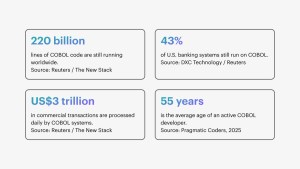
220 billion lines of COBOL code are still running worldwide.
Faced with this reality, most organizations find themselves trapped between two equally problematic extremes.
A Java application that simply replicates poorly understood COBOL logic will accumulate the same opacity within 20 years. The real issue is not the programming language, it is the absence of an explicit, governed knowledge model.
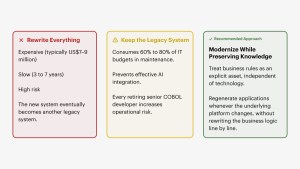
There is one fundamental principle that changes everything:
Business knowledge is an asset that is independent of the technology used to execute it.
Business rules, processes, validations, calculations, and decision logic can all be represented as an explicit, auditable model that is independent of any programming language or platform.
Modernization does not mean discarding decades of business knowledge.
It means preserving that knowledge and regenerating applications on modern technologies.
As technology evolves, from AS/400 to Java, from monoliths to microservices, from on premises infrastructure to the cloud, the application is regenerated from the knowledge model rather than rewritten line by line.
Business intelligence remains constant.
Only the execution platform changes.
This distinction has direct implications for project timelines, costs, traceability, and AI readiness.
GeneXus is a software development platform that uses Deterministic Artificial Intelligence to capture, model, and preserve an organization’s business knowledge, then automatically generates the code and infrastructure required to run it on the chosen target technology.
GeneXus can generate COBOL and RPG code in addition to modern languages. This allows new functionality to be integrated into legacy systems as natural extensions, without forcing intermediate layers, until each module is ready for full migration.
For legacy systems based on COBOL, RPG, PL/I, or AS/400, the modernization process follows five clear steps.
GeneXus analyzes the legacy code using Deterministic AI and extracts business rules, workflows, and data models, separating business logic from its technological implementation.
Existing COBOL or RPG programs can be encapsulated as external objects and exposed through REST or SOAP services.
The legacy system continues operating while modernization progresses module by module.
Using the preserved knowledge model, GeneXus automatically generates code for the target architecture, whether microservices, cloud platforms (Azure, AWS, GCP), .NET, or Java, without requiring developers to rewrite the business logic.
The traditional “all or nothing” migration approach is eliminated.
Legacy and modern applications coexist while new layers incrementally replace legacy modules in a controlled manner, without disrupting critical business operations.
Once the core has been modernized and business knowledge is under governance, AI agents can operate with traceability and confidence, reading, reasoning, making decisions, and acting on systems that now expose clear business semantics.
Concepts without evidence remain theory. The following cases demonstrate measurable results achieved in production environments with demanding operational requirements.
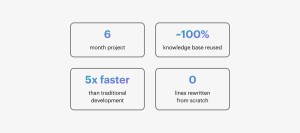
The TCE-MT‘s eSocial system was originally developed using GeneXus X Evolution 1, released in 2010.
The objective was to modernize the application to GeneXus 18, keeping pace with technological evolution without compromising decades of accumulated business rules.
Result: Nearly 100% of the existing knowledge base was reused, with no code rewritten.
The development team focused entirely on business rules rather than technical infrastructure.
“GeneXus reused virtually 100% of our existing knowledge base, enabling integration with modern technologies without requiring us to rewrite the code.”
Edinelson Marcio Menin
Systems Coordinator, TCE-MT
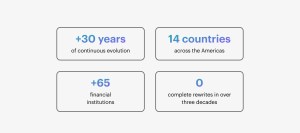
Bantotal is a core banking platform developed by De Larrobla & Asociados (Uruguay) and built entirely with GeneXus since the early 1990s.
Over more than 30 years of operation, the platform has never been rewritten from scratch. Instead, it has continuously been regenerated as technology evolved.
Its technological evolution spans IBM AS/400 green screens, Windows client/server architectures, web applications, and today’s cloud native microservices running on Azure.
Throughout every technological transition, the business knowledge was preserved and regenerated, not discarded.
Two major crises demonstrated the resilience of this approach.
Critical regulatory changes, including currency conversion (“pesification”) and account freezes, were implemented in real time at a speed that traditional systems could not have achieved.
Operational and regulatory changes were absorbed with the same agility, with zero service disruptions across 65 client banks.
An AI agent is, in practice, a system that continuously observes the current state of an organization’s data and business processes, inventory, transactions, customer records, and ongoing operations.
It reasons over that information and performs concrete actions such as approving loans, updating balances, or triggering alerts.
To operate safely in enterprise environments, three essential conditions must exist.
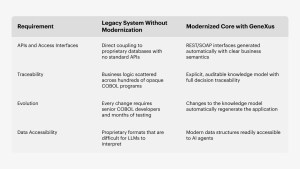
Without these conditions, AI remains confined to the edges of the business, attractive dashboards, customer service chatbots, and low impact automation.
It never reaches the operational core, where the real business value resides.
At this point, the question is no longer whether your organization will adopt AI.
That decision has already been made by the market, your competitors, and your customers’ expectations.
The real question is:
What foundation will you build it on?
If your answer is “our existing legacy systems without change,” you are accepting that AI will remain at the edges of your business while growing maintenance costs continue consuming the budget that could otherwise fund innovation.
If your answer is “we’ll rewrite everything from scratch,” you are accepting years of risk, significant costs, and the loss of accumulated business knowledge, only to end up with another system that will eventually become legacy itself.
There is a third path.
By preserving business knowledge and regenerating applications on modern technology, organizations transform decades of investment into a strategic asset rather than an operational burden.
If you want to turn your legacy systems into AI ready assets, we invite you to schedule a consultation with our team.
We’ll assess your current technology stack and show you a practical path to modernize without rewriting, without disrupting critical operations, and while enabling AI from the very core of your business.
GeneXus and Neuro-Symbolic Architecture
Discover The Campfire Model: Steve Yegge’s proposal prioritizing human collaboration and creativity over AI-driven software development.

GenAI has the potential to revolutionize the utilities sector, including electricity, water, sanitation, and gas.
“Vibe coding” has gained momentum by allowing anyone to generate code using natural language prompts. For prototyping, it’s fun and fast.
Leave a Reply