
Does GeneXus for Agents Work? Here's What Its Users Think
We asked developers who are already working with GeneXus for Agents what their impression of the product is. Here's what they said.

In the context of Generative Artificial Intelligence (GenAI), a prompt is the instruction or natural language input given to an AI model to generate a response, code, image, text, or any other output.
Prompt-based development is the approach of creating software using only natural language instructions (prompts) sent to GenAI models, such as GitHub Copilot, Cursor, and others. In this approach, the developer asks the AI to generate code, functions, or even complete modules by writing what they need as if giving commands or asking questions.
Prompt-based development works for bounded tasks, but when the system grows – when there are multiple modules, complex business rules, integrations, and long-term maintenance requirements – the picture becomes complicated.
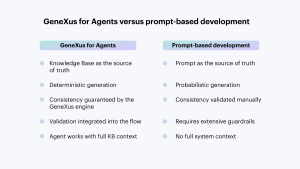
The problem is that the prompt is not a source of truth. It is a text that the model interprets at the moment, without context of the complete system, without knowledge of decisions made six months ago, without access to the underlying data architecture. The result may work today and break something tomorrow.
When AI generates code from an isolated prompt, it faces structural limitations that have nothing to do with model quality:
The result is code that may look correct but can introduce inconsistencies, duplications, or errors that are difficult to detect. As the system grows, these problems accumulate. Validating, correcting, and maintaining that code becomes as costly as writing it from scratch.
For enterprise or mission-critical systems, this is unacceptable. AI speed is worthless if maintenance costs skyrocket or system reliability is compromised.
Language models generate code probabilistically. This means that for the same prompt they can produce different results in different runs, and that output quality depends on factors that are not always controllable: the exact prompt formulation, the included context, the model temperature, and the characteristics of the specific model being used.
In enterprise system development, this is a serious problem. A system cannot be validated if the component generating part of the code is not deterministic. Review, testing, and maintainability become much more costly when there is no guarantee that the same input will produce the same output.
In prompt-based development, the responsibility for system consistency falls on the developer. It is the developer who must ensure that the generated code follows project conventions, integrates correctly with existing modules, and does not introduce inconsistencies.
This involves manual review of every generated fragment, which significantly reduces the speed that AI supposedly contributes. And in large projects, with multiple developers using agents independently, maintaining consistency becomes practically unviable without very robust guardrails.
To use AI agents reliably in system development, teams working with prompts as the sole source of truth need to invest in considerable validation infrastructure: more exhaustive code reviews, broader integration tests, additional linters and static analysis tools, and manual review processes that compensate for the lack of automatic validation.
In other words, the speed contributed by AI is offset by the cost of the additional controls needed to ensure that what is generated is correct, consistent, and maintainable.
This is not about discarding prompt-based agents. They are very useful for automating repetitive tasks, generating prototypes, or solving specific problems – but for enterprise or mission-critical systems, the prompt-only approach is rarely sufficient: it does not guarantee consistency, correctness, or long-term maintainability.
There is a way to integrate Generative AI into system development that does not depend on isolated prompts, does not require extensive manual validation, and does not introduce inconsistencies that accumulate over time.
This solution is called GeneXus for Agents
, and it starts from a premise different from any other AI-assisted development tool: instead of agents operating on free text, they operate on the Knowledge Base (KB)
– the system’s source of truth. The KB is not source code; it is knowledge. The KB contains business rules, relationships between entities, and system conventions. Everything that an experienced developer takes years to internalize, expressed in a format that AI agents can read, reason about, and modify with complete context.
When an agent has access to that KB, it can generate objects that are consistent with the real data model, that respect system conventions, and that do not duplicate existing logic. And before any change is integrated into the system, the GeneXus engine validates it. Subsequently, GeneXus generates the final code. This is not probabilistic generation that someone has to review afterward. It is deterministic generation
, backed by decades of symbolic intelligence built specifically for enterprise systems.
For teams building Mission-Critical Systems, this is the difference between adopting AI responsibly or taking on technical debt that will grow with every iteration. With GeneXus for Agents, AI speed and system guarantees are not a trade-off – they are part of the same flow.
To learn more about GeneXus for Agents, we invite you to visit the website and consult the documentation on the GeneXus Wiki.
GeneXus for Agents: Development with GenAI without losing control
GeneXus in the Era of Agentic Development
We asked developers who are already working with GeneXus for Agents what their impression of the product is. Here's what they said.

In the new GeneXus, the conversation does not directly produce code. It produces a formal, versioned model; code is one of its projections.
Before connecting your KB with any AI tool, there is a question worth asking carefully: do you know exactly where your data goes?
Existe una forma de integrar IA Generativa en el desarrollo de sistemas que no depende de prompts aislados, no requiere validación manual extensiva y no introduce inconsistencias que se acumulan con el tiempo.
Esta solución se llama GeneXus for Agents , y parte de una premisa distinta a la de cualquier otra herramienta de desarrollo asistido por IA: en lugar de que los agentes operen sobre texto libre, operan sobre la Knowledge Base (KB) , la fuente de verdad del sistema. La KB no es código fuente, es conocimiento. La KB contiene las reglas de negocio, las relaciones entre entidades, las convenciones del sistema. Todo lo que un desarrollador experimentado tarda años en incorporar, expresado en un formato que los agentes de IA pueden leer, razonar y modificar con contexto completo.
Los objetos son consistentes con el modelo de datos real, respetan las convenciones del sistema, no duplican lógica existente, de cualquier cambio que se integre al sistema, GeneXus generará el código final. Esto no es generación probabilística que alguien tiene que revisar después. Es generación determinista , respaldada por décadas de inteligencia simbólica construida específicamente para sistemas empresariales.
Los objetos son consistentes con el modelo de datos real, respetan las convenciones del sistema, no duplican lógica existente, de cualquier cambio que se integre al sistema, GeneXus generará el código final. Esto no es generación probabilística que alguien tiene que revisar después. Es generación determinista , respaldada por décadas de inteligencia simbólica construida específicamente para sistemas empresariales.