
Who Are You Giving Your Knowledge Base (KB) To?
Before connecting your KB with any AI tool, there is a question worth asking carefully: do you know exactly where your data goes?
In
the previous articles of this series, we explored why prompt-only development has structural limitations, and why the GeneXus Knowledge Base is the ideal source of truth for Artificial
In
telligence agents. But how does an AI agent concretely interact with the KB? What mechanism makes that conversation between the world of LLMs and the world of GeneXus possible?
The answer is GeneXus MCP Server.
To understand why it matters, we first need to understand what GeneXus for Agents is and what role the MCP Server plays within this GeneXus product.
I invite you to keep reading to review or learn these concepts.
GeneXus for Agents is the layer that allows AI agents to work directly on the GeneXus Knowledge Base – the place where all system knowledge is stored – with access to the complete system context and with the GeneXus engine validation as a consistency guarantee.
In
stead of generating code from isolated prompts, agents propose changes to the KB, the engine validates them, and GeneXus generates the code deterministically.
All of this is made possible by the GeneXus MCP Server.
Before diving deeper into GeneXus MCP Server, we first need to understand what the Model Context Protocol, or MCP, is.
MCP is an open standard designed to solve a specific problem: how to connect AI agents with external data sources and tools in a standardized way.
Before MCP, every tool that wanted to integrate with language models had to develop its own integration, with its own API, its own data format, and its own authentication logic. For agent developers, this meant having to learn and maintain a different integration for every tool they wanted to use.
MCP defines a common protocol: a standard way for any tool to expose its capabilities and data to any compatible AI agent. The result is an ecosystem where integrations are built once and work with any agent that respects the standard.
For AI agents, MCP is a standard that allows connecting any tool with any agent without the need for custom integrations.
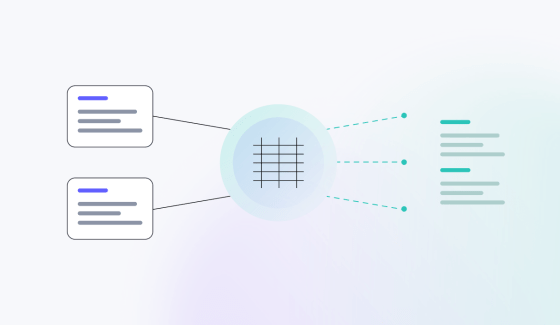
GeneXus MCP Server is the implementation of this protocol for the GeneXus Knowledge Base. It is the component that exposes the KB to the world of AI agents through a standard, controlled, and secure interface.
GeneXus MCP Server allows any MCP-compatible AI agent to:
All of this happens through the standard MCP interface, which means the agent does not need to know anything specific about the internals of GeneXus to interact with the KB. The GeneXus MCP Server translates between the language of the agent and the language of the KB.
To make this more concrete, let’s look at what a typical interaction between an AI agent and the KB would look like through GeneXus MCP Server.
Suppose a developer asks the agent: “Add a supplier management module that includes invoice approval with authorization levels based on amount.”
In
this case, the flow would be as follows:
One of the most important benefits of GeneXus MCP Server is that, by implementing a standard protocol, it makes GeneXus for Agents independent of the language model used by the agent.
The integration with the KB works the same in all cases because the GeneXus MCP Server exposes a standard interface that none of those models need to understand in detail.
This has important implications for teams, allowing them to:
The GeneXus MCP Server is designed to work in the two contexts where modern development teams operate.
From the GeneXus IDE, developers can interact with AI agents visually, integrated into the environment they already know. The agent has access to the KB through the MCP Server, proposes changes, and the developer can review them before they are integrated.
From the CLI (Command Line
In
terface), teams can incorporate AI agents into CI/CD pipelines, automation scripts, or workflows that already use command-line tools. This is key for teams that work with branching, pull requests, and code reviews, because it allows the agent to be part of the development workflow without requiring manual intervention at every step.
Both working modes are compatible with Git and with modern team collaboration workflows. Changes proposed by the agent can go through code review like any other change, keeping human control over what enters the system.
GeneXus MCP Server does not operate in isolation. It is part of a set of components that together make GeneXus for Agents possible:
The GeneXus MCP Server is the glue that holds these pieces together. It is the layer that makes it possible for an external agent, using any LLM, to participate in the development cycle of a GeneXus system with the same reliability and control as if a developer were doing it from the IDE.
The Problem with Prompt-Based Development
GeneXus for Agents: Development with GenAI without losing control
GeneXus in the Era of Agentic Development
Before connecting your KB with any AI tool, there is a question worth asking carefully: do you know exactly where your data goes?
Discover how the GeneXus Knowledge Base empowers AI agents with a single source of truth for reliable, validated code generation.
See why prompt-based development fails enterprise systems and how GeneXus for Agents delivers deterministic, AI-driven code generation.
Leave a Reply