


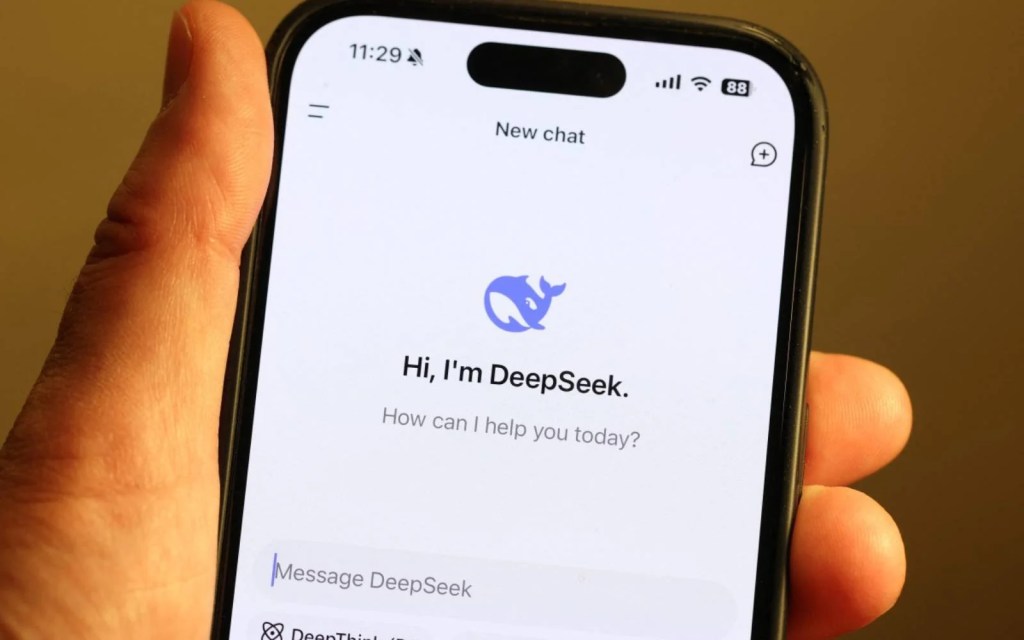
With DeepSeek, we are once again witnessing a
disruption in artificial intelligence
.
Really? Didn’t we just have one last year, or was it the
year before
? Isn’t what’s happening now part of the same thing we’ve already experienced?
Yes, it’s part of what we’ve seen before, but it’s also a new milestone. At the very least, we’re in a stage where companies developing AI are rethinking “how they do things.”
The star of the moment,
DeepSeek
, is a Chinese AI company that has managed to develop advanced AI models at surprisingly low costs while using
less computing power
(or at least, not relying on cutting-edge technology).
This is
shaking up markets
—why? Because it deviates from the expected evolutionary path and questions the presumed winners in the race for AI dominance (the usual incumbents).
But if we look beyond the noise, this is just another example of innovation: Innovation thrives under restrictions and competition. It’s not surprising that a DeepSeek emerged. And if it hadn’t been DeepSeek, it would have been someone else.
Download our free
Innovation “Powered by Restrictions”
Innovation doesn’t follow a straight path. It’s more like a labyrinth—full of twists, trials, errors, dead ends, adjustments, and iterations. Or, borrowing a term from
Gastón Milano
(CTO of GeneXus), innovation advances in a spiral. An exponential, fractal, convoluted spiral—not linear at all. Interestingly, it’s often restrictions—competition, resource scarcity, or inefficiencies—that act as catalysts for revolutionary breakthroughs, the kind of directional shifts and leaps that catch us by surprise.
Let’s recall some classic examples: during the Cold War, the space race fueled technological advances that later transformed daily life, like microwaves and communication satellites. And
velcro
! Or post-war Japan, where resource scarcity led to the development of “
lean manufacturing
” techniques that revolutionized the industry.
DeepSeek
is a perfect example of this phenomenon. In a world where AI development is associated with massive investments and ever-increasing energy consumption, this company has optimized its models using alternative methods that drastically reduce costs and environmental impact.
DeepSeek: Doing More with Less
Instead of
relying on expensive GPUs
, DeepSeek has
found alternative, more cost-effective ways to train its AI models
. This not only reduces operational costs for the company but also takes a step toward making the technology more accessible to everyone.
While the U.S. prepares for a $500 billion investment in AI
, DeepSeek presents an alternative, budget-friendly path—
just in time
.
Why is it so important for AI to be cheaper and more energy-efficient? It comes down to three key reasons: people, businesses, and the planet.
-
For people
More accessible AI means more people and organizations can use it to solve everyday or work-related problems, from improving education to optimizing various jobs.
-
For businesses
Lower costs enable even small and medium-sized companies to implement AI solutions, fostering innovation and competition. Medium-sized companies can now train their own models using DeepSeek’s new techniques.
-
For the planet
The current energy footprint of AI is massive
. If we want a sustainable future, we need models that require less energy—something that’s not utopian. After all, the human brain operates on just 20 watts of power, which is minuscule compared to what today’s AI systems consume.
From Sputnik to the Transistor: Lessons from History
Some compare DeepSeek’s breakthroughs to a
“Sputnik moment” for AI
, but I think it’s more akin to the
invention of the transistor
. Sputnik was an event that woke up the world and shook the pride of the U.S., accelerating competition and the space race. The impact of the transistor, however, was deeper. (In fact, today’s
AI revolution stands on the foundation of that seed planted 78 years ago
.) The transistor marked the beginning of an era of efficiency and scalability, enabling modern electronics and changing everything.
DeepSeek is doing something similar. Current AI consumes enormous amounts of energy and resources, which is unsustainable in the long run. If we want AI to fulfill its promise, we need models that are not just more powerful but also more efficient. This is where DeepSeek is making a difference, showing that we can do more with less.
An alternative example: The Moneyball Strategy
A good example of this dynamic is the
story of Moneyball
in professional baseball. The Oakland Athletics used data analytics to compete against wealthier teams, demonstrating that intelligence and innovation can level the playing field
(
by playing smarter, not more expensively
).
DeepSeek is applying a similar approach to AI: succeeding by pursuing efficiency and results with limited resources. This also highlights a key lesson—innovation isn’t just a game of large resources; it’s about how you use what you have. In the end, DeepSeek is challenging expectations in the technological evolution of AI by doing “what truly innovative companies do in their early garage days” (think HP, Apple, Google).
Where are we headed?
The markets are nervous
, and that’s understandable. Disruptions always create uncertainty, but they’re also a sign that something big is happening. Now, we’ll have to wait for the response from the major players. After all, there’s nothing DeepSeek has done that OpenAI—or anyone else—couldn’t replicate.
The near future of AI will likely be a blend of innovation driven by resourceful techniques like those of DeepSeek and large-scale resource utilization.
Markets may have temporary doubts during these shakeups
, but that’s part of progress. DeepSeek’s advances remind us that
restrictions and competition are powerful accelerators of innovation
. Let’s not forget that when someone breaks a barrier (remember “
Attention is All You Need
”?), everyone who follows benefits.
Today, it seems that a more efficient, equitable, and sustainable future for AI has arrived many years ahead of schedule. And at the end of the day, that’s a good thing.
You may also be interested in reading:
What is Globant Enterprise AI?
Recording the GeneXus Live Deep Dives